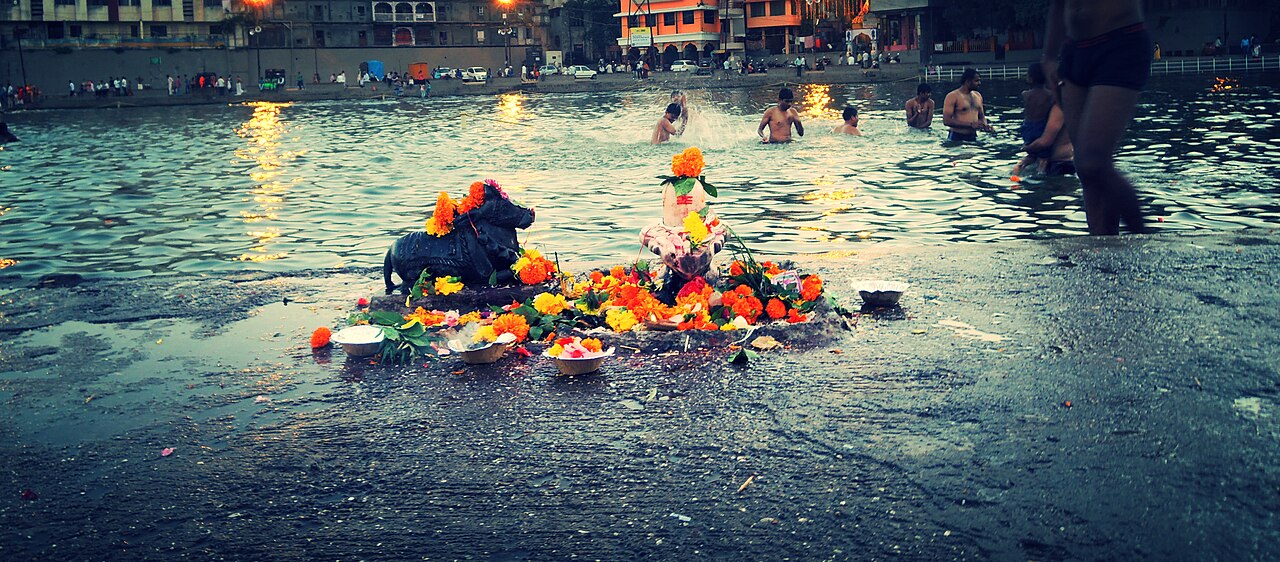
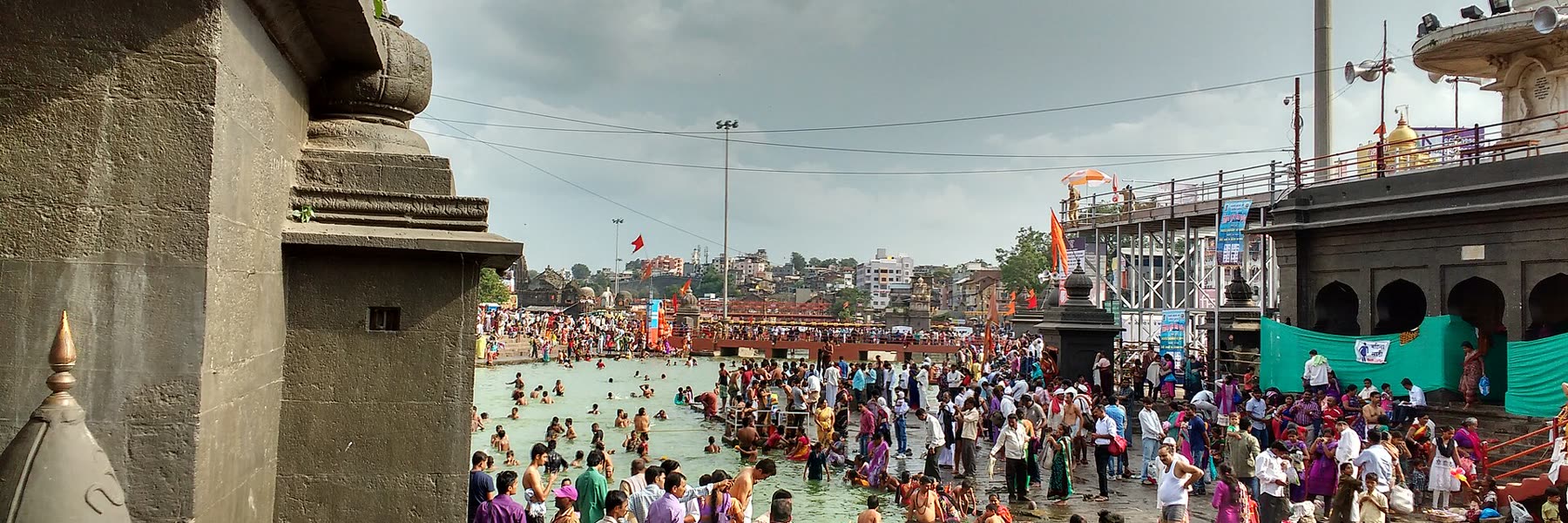
The next Kumbh Mela in the cycle is at Nashik and Trimbakeshwar, and the state's first-edition plan places its major period in June–September 2027. The plan is explicitly provisional: it lists Amrit Snan bathing days on 2 and 31 August and 11–12 September 2027, and says the schedule can still change.
LocationNashik & Trimbakeshwar, India
Edition timingMajor period June–September 2027 · Amrit Snan 2 and 31 August, 11–12 September (state plan, provisional)
AccessPublic religious observance; no general-entry ticket verified
Timing: Major period June–September 2027 · Amrit Snan 2 and 31 August, 11–12 September (state plan, provisional)
Venue or host area: Nashik and Trimbakeshwar in Maharashtra: bathing at the Godavari ghats in Nashik and at Kushavarta in Trimbakeshwar, with the temple towns themselves as the gathering areas. The plan's administrative window runs 31 October 2026–29 July 2028; the 2027 bathing days are the part that matters for a visitor.
Access: Bathing days are a public observance rather than a ticketed event, and no official admission price or ticket portal was verified. Tents, camps, transport and guided packages are sold commercially by third parties. A paid package does not establish access to a ghat on a principal bathing day, when access is controlled by crowd management.
02 · Plan the visit
Plan around the official access route
The state plan proposes shuttle last-mile links, rail and bus coordination and pedestrian corridors, and identifies Trimbakeshwar's limited space as a constraint — but those are proposals, not operating instructions. It estimates 12 crore pilgrims across the event and anticipates extreme concentration on principal bathing days. Treat any parking area, holding zone or walking route as current only when the district administration publishes it for that specific day.
Confirm the edition: use the organiser’s latest date and venue announcement, not only a customary month.
Confirm admission: check whether access is by purchase, ballot, qualification, application or free/public entry; do not assume a ticket includes every venue or session.
Confirm local logistics: check current transport, accessibility, road closures and arrival instructions with the organiser and relevant local authority.
Protect flexibility: compare cancellation terms before booking travel around a date or route that is not fully confirmed.
03 · Location
Getting to Nashik and Trimbakeshwar
Two temple towns in the Western Ghats of Maharashtra, joined by a road through vineyards, with the Godavari running through Nashik.
The airports serving Nashik and Trimbakeshwar and its region:
Mumbai Chhatrapati Shivaji Maharaj International AirportBOM
Pune AirportPNQ
Connections, terminals and transfer arrangements change — confirm them with the airline and the organiser rather than planning around a fixed transfer time.
The venue
Nashik and Trimbakeshwar in Maharashtra: bathing at the Godavari ghats in Nashik and at Kushavarta in Trimbakeshwar, with the temple towns themselves as the gathering areas. The plan's administrative window runs 31 October 2026–29 July 2028; the 2027 bathing days are the part that matters for a visitor.
The catalogue marker shows Nashik & Trimbakeshwar, India at city or region level only — it is not an entrance, a gate, a course or a transfer route. For the event’s position among its category peers, open the Culture & faith overview and map.
04 · Overview
What this event is
A Hindu pilgrimage that rotates between four Indian cities, where pilgrims bathe in a sacred river on auspicious days. The 2027 edition is the Simhastha at Nashik and Trimbakeshwar on the Godavari, with the state's plan placing the major bathing days — the Amrit Snan — in late August and mid-September, and a temporary tent city built to hold millions.
The Kumbh is the largest gathering of people anywhere in the world, with tens of millions attending across the festival period, and its logistics — bridges, pontoon crossings, lost-person centres, police cordons — are studied as a case in crowd management. The bathing days are the peak, and the akharas, the monastic orders that lead the processions to the water, are the event's ceremonial core.
History
The Kumbh's mythology centres on the churning of the ocean and drops of nectar falling at four places, and its organisation in something like the modern form dates from the 19th century under British administration. UNESCO inscribed the Kumbh Mela on its intangible heritage list in 2017. Nashik's Simhastha comes round roughly every twelve years, which is why it is a once-in-a-generation trip.
Kumbh Mela (Nashik–Trimbakeshwar) at a glance
2027 host
Nashik and Trimbakeshwar
River
Godavari
Cycle
Roughly every 12 years per city
Heritage
UNESCO intangible heritage, 2017
Scale
Tens of millions across the period
05 · Research & credits
Sources and photo credit
Evidence and event information reviewed 2026-10-31. Published edition facts are separated from typical timing and historical context.
What we could not verify
The final bathing calendar depends on the state's revised plan; the reviewed version calls itself dynamic and non-binding.
No official visitor ticket rule, camp allocation system or accessible-ghat arrangement was published at review.
Road closures, holding areas and shuttle operations for each bathing day were not published, and cannot be inferred from the plan's proposals.
Kumbh Mela (Nashik–Trimbakeshwar) — BOMBMAN from Mumbai, India · Kumbh @ Nashik 2015 (21752545956).jpg · CC BY 2.0 · archival year 2015 · CSS-cropped to 16:10 overview cards and a 4:3 guide image
No affiliate links. This guide is for travel planning, not a guarantee of entry or event conditions.