Choose the breadth of the trip before deciding how to travel. The Golden Triangle layers Delhi’s city life and monuments, Agra’s Mughal heritage and Jaipur’s forts into one journey. A Taj Mahal focus gives Agra more of your attention with fewer city changes.
Now decide how to make your chosen trip work. For the Golden Triangle, compare a tour with organizing it yourself. For a Taj Mahal visit, choose a day trip or overnight stay, then arrange transport.
The Golden Triangle · tour or independent travel?
Take a tour
A tour coordinates the Delhi–Agra–Jaipur journey. Choose a group departure for a fixed itinerary or a private tour for more control over hotels and stops. Compare time in each city and check whether transport, local guides, entry and the main mausoleum are included.
Choose your own hotels and pace, then connect Delhi, Agra and Jaipur by train, bus or a hired driver. Book city-to-city travel and local transfers separately. A driver makes intermediate stops easier; trains require attention to the departure and arrival stations.
A day tour coordinates transfers; independent rail travel gives control over bookings; a car adds flexibility. Match entry tickets to your arrival and return connection, and check the main-mausoleum option.
A personal perspective on the visit, and the choices I’d make next time.
My experience
A guided Golden Triangle tour, hotels included, starting in Delhi and travelling by car. In my mind that was the right decision: traffic in India is on a whole other level, and having someone else handle the driving and the hotels meant the trip was about the sights rather than the logistics. Our guide was fantastic, and the whole thing was very affordable.
If I went again
The one thing I would change is the timing. We went in late March, when it was already getting hot — 30 °C and above. Early March would be kinder.
Next Planning details
04The field guide
More planning details
Connect the Delhi–Agra journey with an overnight stay, or carry the visit onward through the Golden Triangle.
01 · Arrival
Agra
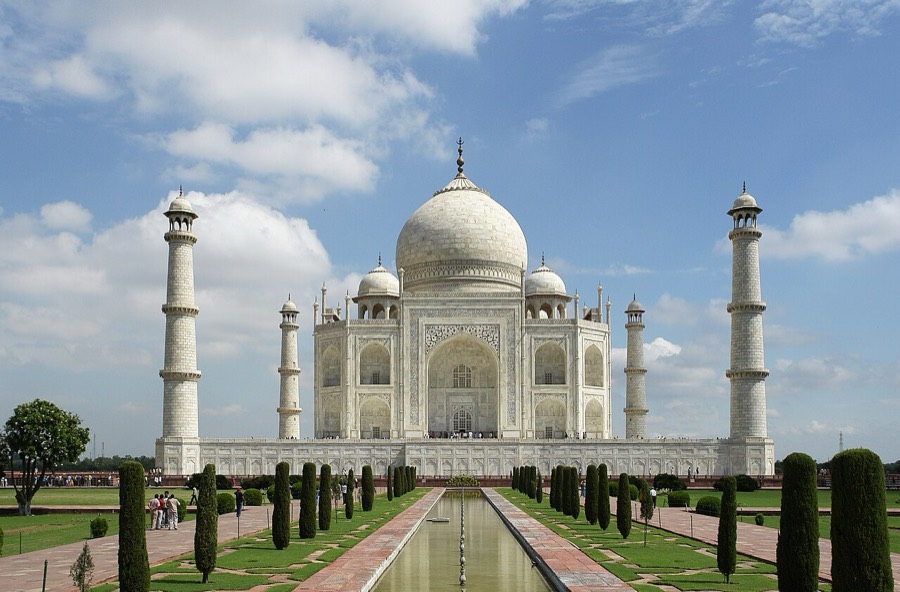
The Taj Mahal is in Agra, beside the Yamuna River in Uttar Pradesh. Built by Shah Jahan in memory of Mumtaz Mahal, the marble mausoleum is the city’s best-known landmark. Agra is both a destination in its own right and the Taj Mahal stop on the Golden Triangle.
Delhi and Agra have regular rail connections. Agra Cantt is the main station, with onward taxis and auto-rickshaws to the Taj Mahal. Check the departure station, journey time, and return service before booking; different Delhi trains use different stations.
A driver, tour, or intercity bus can connect Delhi with Agra; the Yamuna Expressway is a common road route. Road travel gives more control over stops, while traffic affects the total journey. If arriving at Delhi Airport (DEL), include the airport transfer in your plan.
A same-day visit from Delhi is possible, but both options involve an early start and a return journey after sightseeing. A tour coordinates the transfers; independent travel gives you control over bookings and the pace of the day.
Guided option
Day trip with a tour
Choose a road tour or a package with rail travel and local transfers. Confirm whether the price includes entry, the main mausoleum, a guide, and Agra Fort. The main drawback is the fixed itinerary: sightseeing time and additional stops depend on the operator. The Taj Mahal is closed to general visitors on Fridays.
Book outward and return trains or arrange a driver, then buy the Taj Mahal entry ticket separately. Add the main mausoleum ticket if you want to go inside. Allow time for station transfers, security, and the return connection; an overnight stay is simpler if visiting around sunrise is your priority.
Travel to Agra the day before, stay overnight, and visit the Taj Mahal the next morning. This gives you a calmer start and separates the monument visit from the journey out of Delhi.
An early visit without the long drive
Staying locally makes it easier to reach the entrance around sunrise. The official site lists opening 30 minutes before sunrise and closing 30 minutes before sunset, with no general viewing on Fridays. Choose your Agra night around the day you want to enter.
Use the afternoon for Agra Fort or Itimad-ud-Daulah, then leave room for rest before the Taj Mahal visit. An extra night gives more flexibility if travel delays or poor visibility affect your plans, although each new entry requires the appropriate ticket.
The Golden Triangle connects Delhi, Agra, and Jaipur—the three dots on the India map above. A useful starting plan is five to seven days: roughly two nights in Delhi, one or two in Agra, and two in Jaipur. Travel in either direction and fit the Agra stop around the Taj Mahal’s Friday closure.
Begin with Delhi’s layers of history: Old Delhi’s streets and markets, Humayun’s Tomb, and Qutub Minar. Staying before the Agra journey gives you time to settle in and turns Delhi into part of the trip rather than just an airport connection.
Stay overnight for the Taj Mahal, then add Agra Fort to understand the wider Mughal setting. If travelling onward to Jaipur by road, Fatehpur Sikri can be a planned stop; give it its own sightseeing time instead of treating it as a quick roadside visit.
Jaipur adds Rajasthan’s royal architecture and historic streets to the journey. Give Amer Fort, City Palace, Hawa Mahal, and Jantar Mantar time across your stay, with space for the bazaars. The experience complements Agra’s Mughal monuments.
A driver or organized tour simplifies hotel transfers and stops between cities. Trains and intercity buses also make an independent route possible; book the actual city-to-city services and allow transfer time. Continue from Jaipur or return to Delhi, leaving a buffer before an international flight.
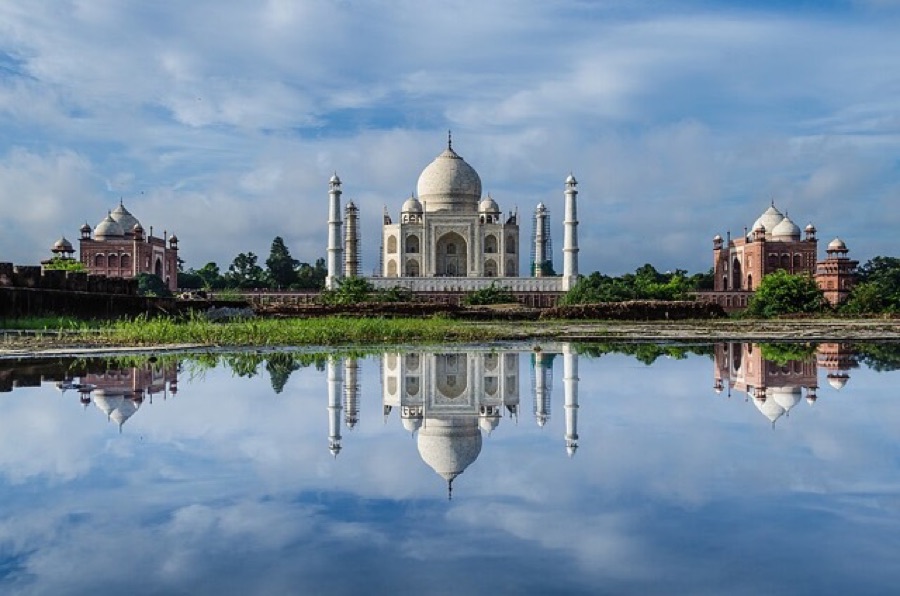
Most visits only see the south face, through the great gate. Across the Yamuna, Mehtab Bagh — the “Moonlight Garden” — sits directly opposite the mausoleum and looks onto its northern face, with the river between you and the marble. It is the wide view: the whole building, both flanking buildings and the dome, rather than the cropped one you get from inside the complex.
A Mughal charbagh laid out under Babur and later aligned with the Taj by Shah Jahan, so the garden’s axis points straight at the mausoleum. Excavations here uncovered a large octagonal pool with 25 fountains — the source of the reflection shot. You are roughly 300 m from the building, looking at the face the postcards leave out.
Time it for the light
The last hour before sunset is the reason to come: low light warms the marble and the garden empties out. Sunrise is quieter and often mistier on the river. Midday is flat and hot. In December and January, fog can hide the Taj completely — check visibility before you set off.
Tickets, hours and getting there
A separate, cheap ticket: about ₹25 for Indian, SAARC and BIMSTEC visitors and ₹300 for other foreign nationals, free under 15. Open sunrise to sunset, every day — including Friday, when the Taj itself is closed, which makes it the best use of a Friday in Agra. It is 7–8 km by road because you cross the Yamuna bridge; no food inside, so carry water.
The reflection depends on the river: after a dry spell there may be little water in front of the garden, and in the monsoon it can be full but under cloud. This is a viewpoint, not an alternative to entering the Taj Mahal — you cannot reach the monument from this bank. Fees and hours are set by the ASI and the Agra Development Authority and do change; check before travelling.