Organize it yourself or take a tour?
Independently, coordinate the site ticket, train, shuttle and any guide separately. A tour handles the connections; check exactly what is included and which site circuit you will visit.
Peru · Visitor guide
Choose how much you want to hike, then work backwards through your tickets, transport and time in the Cusco area.
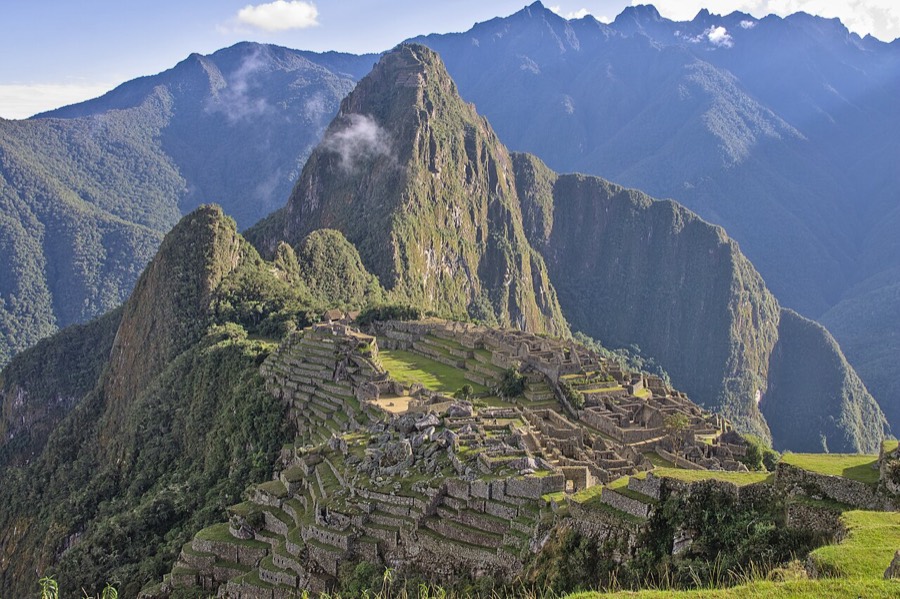
Decide whether Machu Picchu is the main visit or the culmination of a hiking journey. All options include walking and steps at the site; the difference is how much mountain terrain, time and physical effort you want to add before or during the visit.
Strategic decision 1
Option photosTrain — Gerry Zambonini (CC BY-SA 2.0)Sun Gate — Christoph Strässler (CC BY-SA 2.0)Inca Trail — EnriqueGuia (CC BY-SA 4.0)
Strategic decision 2
Pick the areas and views you want before booking transport. Ten routes sit inside the three circuits: four are the standard walking route of a circuit, and six are booked separately — three mountain climbs and three extension routes. Skip the optional ones if you want less exertion; even a standard visit involves uneven paths and steps.
Swipe the diagram sideways to see all three circuits →
The three circuits at a glance
Solid line = circuit route · dashed = booked separately
Circuit 1 · Panoramic
upper terraces and the classic view
Main route
Optional · booked separately
Circuit 2 · Classic
main gate, plaza and temples
Circuit 3 · Royalty
eastern sector and Huayna Picchu
Main route
Optional · booked separately
Schematic, not to scale. Route names follow the official circuit system in force since 1 June 2024; each circuit is one ticket, and optional routes need their own. Official circuit list ↗
Explore the settingsPeru’s trekking routes ↗Official site circuits ↗Sanctuary visitor guide ↗
Use your hiking preference to narrow the next decisions: how to organize the trip, where to stay, and which trail or site circuit to book. Coordinate those choices with your transport rather than treating each ticket as a separate purchase.
Low hiking · train + shuttle bus
Independently, coordinate the site ticket, train, shuttle and any guide separately. A tour handles the connections; check exactly what is included and which site circuit you will visit.
A day trip saves a hotel change but means a long travel day. Staying in Machu Picchu Pueblo puts you closer to an early entry. Check whether your train uses a road transfer or runs directly from Cusco on your date.
Medium hiking · choose one main hike
Choose a two-day itinerary with one main hiking day from km 104 via Wiñaywayna and Intipunku, followed by an overnight stay and a site visit. Book through an authorized operator and confirm the included site circuit.
Stay overnight and choose a specific hiking ticket. Huchuypicchu is one option within Circuit 3; Intipunku is Route 1-C in Circuit 1. Availability can be seasonal. Compare the climb and entry window before choosing.
Take the train to town, then climb to the entrance on foot. PeruRail estimates about two hours uphill; it adds substantial effort before sightseeing. You can consider a bus in one direction instead.
Circuit 3 is a family of routes inside Machu Picchu, not a multi-day trek. Its routes vary in effort; Waynapicchu and the Great Cavern are more demanding choices.
High hiking · choose your multi-day trek
The classic Inca Trail is usually four days, reaching the site through the Sun Gate. Salkantay and Lares offer different mountain and community experiences, usually connecting onward to town rather than using the same approach.
Inca Trail access requires an authorized operator. Compare walking days, altitude, camping or lodging, support, transfers and the exact Machu Picchu ticket. Alternative treks do not automatically include access to the Inca Trail.
Allow time in the Cusco or Sacred Valley area before strenuous hiking. Match the trek departure, site visit and return train before buying separate bookings.
From my travels
A personal perspective on the visit, and the choices I’d make next time.
I went as a day trip from Cusco, mostly because I only had 12 days in Peru. The day itself was fine. The car ride from Cusco to Ollantaytambo was quite bumpy; other than that, everything went smoothly. Mid-October was perfect — it wasn’t terribly busy, and the weather was still good.
You need more than 12 days to see southern Peru. Two weeks minimum — I should have taken the full 16 days rather than 12 — and roughly this shape:
For Machu Picchu itself I would skip the tour and book the train from Cusco myself, then use three days for Circuit 1 and Circuit 3-A plus the walk to the Sun Gate. Three days also leaves room to absorb a bad-weather day.
The field guide
Start in Cusco, compare the train arrangements, then take a closer look at shorter hikes and longer trails.
01 · Arrival
Cusco is the former Inca imperial capital and a UNESCO World Heritage city, where Inca stonework and colonial-era architecture sit side by side. It is the usual starting base for the Sacred Valley, the rail journey, and treks toward Machu Picchu. UNESCO city profile
Getting there from Lima
Fly from Jorge Chávez International Airport (LIM) to Alejandro Velasco Astete Airport (CUZ). The average flight takes about 1 hour 20 minutes, and LATAM lists multiple daily services.
Travel overland from Lima to Arequipa, continue to Puno, then take the scenic PeruRail Titicaca to Cusco (about 10½ hours). Allow several days for the route, including time in Cusco to adjust to the altitude before strenuous hikes.
02 · A day visit
A same-day visit from Cusco is possible by train, with a guided tour or a self-planned journey. Both make for a long day: tours coordinate the connections, while independent travel gives you control over each booking.
Most Cusco-based day tours take you by road to Ollantaytambo, then by train to Machu Picchu Pueblo. The shuttle is a drawback: the country road can be in poor condition, and roadworks or congestion may add delays. Confirm the route and transfer conditions with the operator.
PeruRail sells tickets at San Pedro station in Cusco and offers direct trains from there, so you can skip the road shuttle to Ollantaytambo. Check service for your travel date, book a timed entry ticket that fits your train, and leave a buffer for the shuttle bus from Machu Picchu Pueblo up to the citadel.
03 · An overnight stay
Take the train to Machu Picchu Pueblo the day before your visit and stay overnight. You can explore at a comfortable pace without squeezing the citadel into a long Cusco day trip.
An overnight stay gives you room for an early entry and a slower visit. An extra night can also give you options if weather or transport delays disrupt the plan, subject to ticket and train availability.
Some Circuit 3 hiking routes have early entry windows that may not line up with a same-day train from Cusco. Routes 3C (Great Cavern) and 3D (Huchuypicchu) are available only in high season, so check the route, date, and entry time before booking.
04 · Walks & trails
Reach Machu Picchu on foot through an Inca Trail route or a longer alternative through the Andes. Treks range from one day to several days, with different permit rules, terrain, and levels of support.
The classic route takes about four days and three nights, passing Inca sites and mountain scenery before reaching Machu Picchu through Intipunku, the Sun Gate. Entry to the Inca Trail network must be booked through an authorized operator, so plan ahead.
This one-day route starts at kilometer 104 and covers about 10.5 km, including Wiñaywayna, before arriving at Machu Picchu through Intipunku. It offers a taste of the Inca Trail without a multi-night trek, but still requires an authorized operator.
A roughly five-day alternative travels through high Andean scenery near Salkantay, with a route via Soraypampa and Humantay Lake toward Machu Picchu. It is a strenuous, high-altitude option; guided and independent itineraries are available, so assess conditions and your experience before choosing.
A four-day route through highland communities and mountain landscapes, Lares is a cultural alternative to the Inca Trail. It typically links the Lares Valley with Ollantaytambo and onward travel to Machu Picchu, rather than following the Inca Trail itself.